All Articles FROM the OLD Adsubculture.com
Recent Articles
How do we accomplish the impossible?
How do we make a big idea come alive? How do we make something that never existed before real? Everyone, will be asked at least once (although as project managers it seems like everyday), to make the seemingly undoable, doable. Under impossible conditions and overwhelming odds, we will be challenged to make crazy asks, happen.
In 1990, at the age of twenty-one, I was lucky enough to land my first job with a small creative marketing firm, where I was equally lucky enough to encounter my first mentor, Curt. Through the years, Curt would impart many, valuable lessons. He believed in creating a culture that support self-organized teams, where everyone was valued, contributed, played a role and helped each other to problem solve.
It was a collective of people that were united, passionate and full of energy. They loved to make stuff, whether for a client or themselves. It was that passion and constant activity that seemed to provide a never ending boost for everyone.
How do we adapt to change?
Change is happening in every organization, across every department and in every geography. Change is not limited to self-defined creative organizations or innovative companies. During the past seven years, I have traveling across the USA and have spoken to organizations far and wide. Change is a topic that organizations all over the world are thinking about.
A cross-functional team in a creative firm can take on many forms.
These teams are small groups of individuals that cross formal or informal functional departmental boundaries and levels of hierarchy. The groups are created to commit to a common purpose or goal, typically formed for a project, program or by client for a finite amount of time; the team acts and works as one unit. They communicate frequently, cooperating and providing mutual support, coordinating activities, drawing upon and exploiting the skills and capabilities of each other, while considering the needs of individual members.
Cross-functional teams are formed on the assumption that a small group is better able to accomplish a creative project than individuals acting alone or in a large, permanently structured setting. The belief is that cross-functional teams, improve the quality of the outcome and become committed to see the project through to the end.
In almost every discussion of how to motivate individuals, it’s inevitable that the discussion will turn to some form of reference to Maslow’s Hierarchy of Needs. This is a reference to a pattern that human motivations generally go through. For example, if someone’s basic needs aren’t being met, like their rent, we don’t motivate them by recognizing them with a fifty dollar gift card to Applebee’s.
Unless you know the person really well, it can be hard to determine where they are sit on the hierarchy and how to effectively motivate them. You have to get to know someone a bit to understand what’s the best way of motivating them. As their lives change, so does what will potentially motivate them. You might have a great worker one day, who seems to get motivated purely for doing challenging work, then one day they kind of shut down. We might think that they are getting bored, or don’t feel challenged any more. We may worry that they are now looking for a job.

Over fifteen years ago I started writing about creative agency operations. It started out as a necessity, to teach the people in the agency’s I worked for how to get work done. As a creative producer, I knew that if I taught people how to work together and get their act together, then I would gain time. Time to craft, time to get ideas made, time to do more with less.
It started out as a survival tactic. If I could teach everyone in the agency what was expected of them, then when it came to working outside the normal way of doing things, then people made rational decisions.
Together, we will figure it out and get it done.
Culture in an ad agency is unique to the place and the personalities of the people running the shop. There is the outward agency persona, and then there is the inward true cultural persona of the agency that we all work within.
WHY DO AGENCIES TRY SO HARD TO SHOW THEIR INNER WORKINGS?
Agencies are a business and the established distinctive culture of the place is there on purpose. For one thing, as a brand seeks a potential agency partner, they look for agencies that would be a good working relationship fit. An agency's culture is part of what the shop is selling to a client. It is part of the promise to the client, on what type of work they are going to get and how they are going to work together to get there. If the agency is all about ROI and analytics, think about the types of people and processes that would be in place as opposed to an agency that is known for design or an agency that is known for very out-of-the-box thinking...
Creative land can be stressful.
We have deadlines, demanding clients, and people that we work with that can drive us mad. The terms "creative shop" and “sweatshop" are too often used interchangeably when it comes to describing certain work environments. Working late nights, on the weekends, or on vacation is considered normal. A creative career with a positive work-life balance is often very hard to come by.
Truth be told, many organizations value “the work” above all else. The work pays the bills and keep the clients coming. Too often, we forget that it's the people behind the work that make it happen.
As employees, I think we are pretty savvy when it comes to deciding where we work. We know ahead of time what we are getting ourselves into. You can bet we’ve googled the company and its leadership, and checked out the dirt on industry blogs. Our friends have told us about the environment, the recruiter used certain words to clue us in, and quite frankly, the company’s values are pretty much out in the open.

How do we get project managers to think beyond basic project goals? By remembering that creative assignments are a set of accomplishments beyond being on-time and on-budget.
One of the reasons why I hesitate on the "traffic manager" approach to managing creativity, is that if you ask any traffic manager (and albeit many project managers) what determines a project's success, you are going to hear the single repetitive mantra of "being on-time and on-budget." Traffic managers are good at getting things from point A to point B, fast, but that's because there is a set path. Deviations from that single path, however, can be hard on traffic managers, since they have high accountability for providing regular outcomes on just those two work activities. They don't always think beyond what is provided to them as project objectives.
Traffic managers are rarely given the responsibility or held accountable for a project's holistic goals. Since just like a production manager, they are only held responsible for only part of the bigger project. This is best shown, by the adaptive mantra of, "Pick two: Do you want it on-time, on-budget or good? You can't have all three." As far as measurable metrics go, these three variables are pretty poor. Who and what determines if a project is good or great? Good is a pretty subjective criteria to measure...

Recently, I attended a panel on project management as an audience member. One of the topics that kept coming up was, “What makes a great project manager?” I don’t think the panel ever fully got around to fully answering the heart of the question.
Over the years, my project management style has certainly changed. But when I look back to when and where I was very successful, I can see certain patterns emerge.
Beyond the Mechanics and Taskmaster
If you have ever taken a project management course, or worked on your PMP, you tend to focus on the mechanics of how to manage a project. How to create a scope, a project plan, identifying tasks, navigating process, risk, milestones and deadlines are all things that are taught and learned. Certainly these are skills are important to know, a strong foundation in the basics means you can apply these concepts.
Indeed, knowledge of the mechanics is often one of the key things people look for in a project manager. However, if all you did as a project manager was to apply these concepts religiously, you may find yourself in the role and style of a taskmaster. I think this is where a lot of company’s get it wrong. If you are all business, and driven by tasks, productivity and outcomes, you might find yourself driving people on your team away from working as a team.
I’ll give you an example. I remember when I started at a very well known creative shop. First day on the job, I had a very senior project manager come up to me and announce, “Hi, my name is ______, and I’m a bitch. Get use to it.”
I raised an eyebrow, like I tend to do, and I thought to myself, wow — great first impression, I bet everyone just loves to work with you.
From the outside, upper management thought she was one of the most productive people in the company. And yes, this person got stuff done. This person valued outcomes and this is what management saw, and by providing positive feedback she felt empowered.
So yes, this person got stuff done, but bullied everyone along the way. Did anyone want to work with this individual? No, this empowered person, lacked empathy. While this style may push work through, it wreaked havoc on the creative teams. While this individual may have completed things on time, if you compared this person’s projects with other project managers, you would see some significant differences...

When it comes to managing how work gets done organization wide, advertising agencies are anything but typical when it comes to workflow & process. Part of what makes an agency special (besides the people that work there) is the agency's approach to how they create work. It’s also driven in part, by how the agency tries to carve out a unique place for itself among the hundreds of agencies in at the marketplace.
In the past, we often identified agencies by either being account or creative driven. Now, however, we identify agencies in dozens of different ways from being creative, account, digital, data-driven, interactive with varying 360° experience, a general agency with varying degrees of interactive experience, to name just a few. This fragmentation of focus and company values has lead to a greater variety in workflow paths among agencies.
As experienced managers we know the dangers and pitfalls of having a workflow process that leans toward one of these extremes. It's no wonder that many agencies are re-examining project management and redefining traditional roles within the agency. In the quest to better manage our agencies, we are tearing down traditional silos to create cross-functional teams, but on the opposite end we are also creating new digital silos with technical teams that seem to have a narrower creative function...

Your agency's engine has a dual purpose. First, it needs to be able to drive your agency to develop creative solutions and innovations for you and your clients. Second, your engine is the heart of how you get your team to those solutions. Without out a reliable, and strong engine that can keep up with the evolution of advertising, you may find yourself running out of gas and stuck on the curb.
One of the main reasons why I started this site was to not only share the basics of process and workflow — to provide a starting point in defining what goes on during the creative process — but to make the case that the way an agency operates is a vital, strategic part of the business model.
Throughout the site, you are going to find a variety of ways of doing things, most of it centered around the basics, to help you evaluate what parts you may need to build your own unique agency model. This definition process, I think is vital to help you define and develop your own practices for your own specific agency...

On any given weekend, you may find yourself watching a game. In my house, the sport of choice, both watched and played on the weekends is soccer. As with any team sport, each member of the team needs to work together in order to score a goal. Every member of the team has a particular role but plays with an intricate underlying knowledge of who's on the field and where they are. Some play offense, some defense, but they have enough knowledge and ability to fill a gap if a player needs help. They work together passing the ball forward, backwards and sideways to keep possession of the ball and ultimately to score a goal.
Creativity is also a team sport. The art of solving creative problems requires thinkers, makers and builder to come together to solve business strategies by executing ideas that resonate emotionally and designed for you and me. Project managers along with strategists, creatives, and technologists all play different roles on the field, but the best teams are made up of individuals who not only play well together, but complement and support each other in developing ideas.
If you ever watched a soccer game, every now and then you'll see a player seemingly come out of nowhere and make a play, taking away the ball, acting as interference, blocking or shooting for a goal. It can seem like the reaction was almost instantaneous, and can have the direct effect of changing the tempo of the game. All of a sudden the ball is on the other side of the field, just one more kick a way from making a goal.
In order to be that individual, who can see all the players on the field, the hundreds of variations on where the ball can be kicked or passed to, and be the player to arrive at the exact instance in time where you are needed most is called having field presence. It is the ability to see through all the extraneous distractions, analyze what needs to be done and then act.
While this is especially true of team leaders, anyone on the team can have field presence. However, as a team leader or project manager or producer, it can be an invaluable skill. As someone who may have played sports, or have been on a creative team, I bet you already know what I'm talking about, or at least you've seen someone utilize this skill in the real world. While this can be a natural ability, everyone can improve their own field presence skills. To give you some idea on how you can gain field presence, I'm going to walk through some project management framing questions that can not only help you in managing projects, but help to develop your own project management presence...

The integrated model for agencies is focused on building collaborative teams to strategize, come up with ideas, make, execute, and evolve creative projects together. It is a more dramatic way of tearing down silos in an agency. While all agencies have their own core business model, these diagrams show how a small team can be built to work together in a design thinking "like" environment. Successive slides show how the team can work with the larger agency group.
The idea is, as you move out of the core, you either bring in new players to the team, or the team members themselves use their "T" shaped knowledge of their core function. This also means that the entire team can share and exhibit strategic multi-discipline views on a creative problem.
Please feel free to comment and share your thoughts. In the upcoming weeks, I will be adding to the diagrams.

If you do a quick google search on creative briefs, you’ll find hundreds of articles online. I think this is a testament to how hard it is to write a good brief, since the development of the brief, is as much a part of the creative process as thinking of ideas to answer the brief itself. The creative brief is meant to be the culmination of all the research and strategy completed, an understand of the client’s business, an understanding of the audience and a framing of the goal of the communication – in addition to uncovering the truths and insights about the emotions and behaviors surrounding the brand, consumer and cultural relevance. It's a lot to think about. However, a good creative brief is also meant to spark inspiration while guiding your team through the constraints of objectives, how and where you may engage, and hypothetically how much time and budget is suppose to be spent.
It’s a tall order to create a good brief (and one that is brief). It is no wonder that many briefs, to put it mildly — suck.
We expect clients really do want to engage agencies for their creativity and innovation, as well as the tactical application of strategy. However, sometimes clients get more caught up in a tactical approach to defining projects (writing a 12 page essay chock full of business objectives and must haves) than actually engaging agencies to do what they do best – think...

Managing the creative process is more than just setting and following the rules of typical project management procedures. As a creative industry, you would think that agency's would be better at identifying that the reason for tension and conflict is often created by the formality and rigidness of processes that we put in place to help us be more efficient.
I often look back at my time working at both small agencies and startups with great nostalgia. For those of us who have spent time in similar small organizations, we know what it's like to have that small company, "we can get done," team spirit. Or at least what's it like to work with your slightly awkward extended family.
In small agencies, you often get the impression that very little formal project management is in place. While that's most likely true, what you do feel is that people often feel invested in common goals and that they really believe in the philosophies that founded the agency. In a way, small agencies do act as one very large cohesive team, even though they seem dysfunctional at times. At a small shop, everyone usually knows what's expected of them, what the goals are, how to get the work done, where they want the agency to go, and what they want from the experience. If you had a problem, people talked and communicated. If something was outside of your job, you still felt you could contribute and be appreciated...
If you work in advertising, you know the work can be stressful, filled with last minute changes, long hours and strong egos. There are risks in managing creative projects that are unique to this business. Having spent my formative years in production, the pressure always seemed amplified. If you throw in a hierarchy of creative approvals that extends up the chain at both the agency and the client, managing outside production and ever changing technology needs, you find yourself constantly facing and managing the unknown.
I think keeping an open mind has helped me to not only to manage the unknown and become a better leader, but also aids tremendously when things go wrong...

Big changes in an organization start by identifying the core values that make up your company's culture and which new values you want to incorporate. This set of values acts as the foundation that your company will use to identify and map out the key beliefs that you want everyone in the organization to embody. These core values are the underpinnings of decision making, as a group they let people know the right and wrong ways to behave in the organization. They identify not only what it means to be successful as an individual in the company, but will guide the organization as it maps out a way in which the entire organization will run and face change...

On this site we try and identify the key steps in process and workflow in a typical agency. However, agencies are anything but typical. Part of what makes an agency special (besides the characters that work there) is the agency's approach to how they create work.
We use to identify agencies by either being account or creative driven. Now we identify agencies in dozens of different ways including creative, account, digital, data-driven, interactive with varying 360° experience or general agencies with varying degrees of interactive experience, to name just a few. This fragmentation has lead to a greater variety in workflow paths among agencies.
As experienced managers we know the dangers and pitfalls of having a workflow process that leans toward one of these extremes. It's no wonder that many agencies are re-examining project management and redefining traditional roles within the agency. In the quest to better manage our agencies, we are tearing down traditional silos to create cross-functional teams, on the opposite end we are also creating new digital silos with technical teams that seem to have a narrower creative function.
While advertising is a business, it is still in the business of creativity.
Your account team, your creative department, producers and project managers all need to have a sense of what that statement means. A by the book, strictly business-oriented account or project management centric agency might very well be productive, but the end product may never win awards. Mediocrity doesn't get you to the next level, mediocrity doesn't attract creative talent -- great work created in a great environment does.
Great ideas are crafted.
Building a flexible workflow system in your ad agency is key to building a framework where great ideas can grow and develop. The workflow in your agency shouldn't be overly complex, but it shouldn't be a free-for-all either. Great projects happen when you can build on the basics.
I know what you're thinking.
Its Monday, 9 a.m. and the whole team is gathering in the conference room. People are talking about what they did that weekend, but the looks are restless. Trains are running late and everyone is waiting for the creative director or head of account services to arrive. Status reports are still printing and people are looking at their watches. The warning signs that this may be a long meeting are already there.
Do you start? Do you wait? Do you dread this is going to be another wasted morning?
If you want ideas to evolve, you can't rush creativity. As a project or creative manager we need to be creative in how we manage the creative portion of the process.
In this site, you will find many tools and articles on how an ad agency needs to and how it does track time. Time is such an important part of the business. We charge for our time, we have limited time and we track time. In the agency world it seems we are all a little too time obsessed. However, unlike our nice and neat SOWs and time estimates, the time it takes for a creative idea to happen doesn't work in neat 4 or 8 hour blocks of time.
The Drop Dead Date.
In this day and age, the gravity of the phrase, "drop dead date," is lost in translation. Just what does this phrase mean? As any salt-worthy project manager and producer knows, it can mean just about anything.
However be savvy when examining deadlines. Just because someone give you a rush date, you need to do a background check to ensure this is the real due date. Its up to you as a project manager to find out if the date is fixed, flexible, past-due or just plain made up. In some cases, there may be other due dates prior to the final deadline that are even more important. For example, quick deadlines can mean very short client approval times. Your client may have very restrictive approval dates and times. It's essential for you to find out up front.
In my last entry, I spoke at length about the importance of developing a sound creative brief. One of the most important aspects of developing that brief is the gathering of information from various teams and compiling the information into an easy to read and understand, working document.
Accounting Articles
Account Services
The role of the account person in an agency has changed dramatically through the years. In the past, we asked a lot of our account or client services people. They may have handled the entire client engagement, from participating in generating new clients, to developing client strategy, to acting as the sole project manager in the agency through estimating to billing.
The account person of the past may have had the largest job description of any individual role in the company.
Times have changed, and creative firms and agencies have morphed and solidified the role of account person into three, four or five different disciplines. The account person generalist has been split off into some very different specialty roles, engagement management, strategic development, project management, marketing partner and user experience development...
Creative
Operations
One of the last components of building an agency model that supports your agency’s model are the actual people that work within your agency. It’s not all about what type of project manager you have in your agency that supports one process or another, it’s what type of people you have in your agency that can also support and be a part of your agency model.
A lot of the value an agency can provide to a client is based on the people in the agency. This is where ideas, speed, innovation, and technical know-how comes from.
Integrating project management and the creative process
Managing the creative process is more than just setting and following the rules of typical project management procedures. As a creative industry, you would think that agency’s would be better at identifying that the reason for tension and conflict is often created by the formality and rigidness of processes that we put in place to help us be more efficient.
I often look back at my time working at both small agencies and startups with great nostalgia. For those of us who have spent time in similar small organizations, we know what it’s like to have that small company, “we can get it done,” team spirit. Or at least what’s it like to work with your slightly awkward extended family
If you are a new agency entity, your foundation building is going to be a lot simpler than changing an existing agency’s model.
Building something new or from scratch can also be pretty similar, the one constant you both have are your people. What may be different is how set everyone is in their old ways of working and a willingness to do something different. For management, we know that we need to have a business plan and some strategic idea of where we want to go.
Why Developing an Agency Culture is Important
Culture in an ad agency is unique to the place and the personalities of the people running the shop. There is the outward agency persona, and then there is the inward true cultural persona of the agency that we all work within.
Learn to talk about what you do, and how you do it.
It doesn’t matter if you are an agency owner, an account person, a project manager or a developer, everyone in the agency needs to be able to talk to a client. You should be able to tell them why you are working a certain way, and why your way of doing things is important to your process.
Creative projects, technical or not, require a high-level of client/agency trust. When everyone in the agency feels comfortable enough to talk to a client, then both sides can be at ease and have a clear understanding of expectations...
Project Management

Agency’s adapted integrated processes at a point where separating interactive, broadcast and traditional no-longer made sense. It was a way for agency’s to begin to coordinate marketing efforts across these platforms and to plan out how you share production resources between all of these efforts.
In reality, the idea of integrated marketing is nothing new (it’s about communicating across platforms), what was new was agency adoption of Integrated Process Methodologies as a theory for managing projects. When you think about it, adopting integrated process methodologies made sense, since creative organizations already worked in similar ways.
In today’s creative firm, you are going to work with a range of team members. The size and make up of your team is going to vary from project-to-project, agency to agency. What one person is called versus what they actual do at an agency can also be very different, just as the definition of a project manager varies widely from one agency to the next.
This is pretty natural and normal. When an agency is small, it has to be flexible. People wear a lot of hats and as the agency grows it morphs and expands based on the need for a specific specialization.
Before we get into the mechanics of what a project manager does (like responsibilities and stuff) we should get something clear. This job can be hard, mind bending and stressful. Even if you are a great “technical player” as my son’s soccer coach puts it, if your interpersonal skills (team skills) aren’t there, you are not going to last long in the position.
Sometimes it can be difficult to work with others. Get to know your team, your client, and your extended co-workers. Get to know as many people in the agency that you can. If you are working in a creative environment (or any environment for that matter) you are probably working with some really interesting people. Get to know them, understand how best to work with them, and your job from a technical standpoint will be a lot easier. The same goes for you as well, let people know who you are, be a real part of the team.
Let’s talk about what it really means to be a creative project manager.
Look through any job board and the job description for creative project managers, producers, program managers, product managers and the like may seem very different. You may work in small or large teams, manage the client, or just production or projects end-to-end. To be a project manager in the big sense of the word- — and not just a traffic manager, your duties will most likely range a lot more than just the creation and management of scopes, budgets, time-lines, resources (people and objects) and project goals.
A project manager’s role is to apply his or her knowledge, skills, experience, processes and methods to achieve a projects objectives. In creative projects, where the objectives are, well, subjective, they often play the often un-discussed role in shaping the creative. A creative project’s objectives are often very undefined, and the choices you make as a project manager, can directly effect the outcome.
This is a power that can be used for both for good and evil. You can just as easily kill a creative idea or support a whole new avenue of discovery.

Creative firms use a variety of project management methodologies.
As project management methods are closely tied into the overall process that exists within an organization, organizations can get pretty creative in how they apply these methodologies.
Sure, there are standard project management methodologies; and as an organization if you follow the standards, you really don't have to go very far to adapt and design these standards to fit your own way of managing projects.
You can borrow from what's out there already, you'll even find a bunch of process charts on this site that you can use a pretty starting point.
The reason we adapt these standards or adapt them to be our own is so that we can set the way we work — to best fit our company's culture and the types of projects we create.
Let's talk about the basics of what it means to be a creative project manager.
If you've already cruised this site, I hope you get the idea that how organizations define the role and title of project managers can be very different.
What your job description entails may also be very different. You may work in small or large teams, manage the client, or just production or projects end-to-end. To be a project manager in the big sense of the word, and not just a traffic manager your duties will most likely range from creation to management of scopes, budgets, timelines, resources (people and objects) and project goals.
However, no matter where you stand, if you have the title or project manager or not, if you have project management responsibility, then your a project manager.
Simply put, a project manager is someone that leads the project management process.
In creative land, just like other industries, a project manager can manage one project, a group of projects, projects from one client or several. They can be big, small or group together for a campaign or launch.
I write about process in the creative environment — a lot. However, for all the linear steps that I have diagramed on the different charts I’ve created, what we all have to understand is that the the creative process itself is really a non-linear journey.
The trick to understanding this journey is to make peace with the concept that there is no “one best way” to move through the creative process. We don’t so much as manage the creative process as guide it along and perhaps ride along with it at times...
Here is an example of what goes into a scope of work, this is a bit more detailed then the simple version on this site. As with all contracts, please review all legalese with your lawyer.
An integrated producer is typically a producer who has a background in either digital or broadcast production, but will and can be called upon to produce a variety of projects for the agency that may not fit in their specialty. Therefore, often integrated producers are really great critical thinkers, who have shown they can manage the unknown...
One of the most important documents in a agency is the agreement between the agency and the client. Most agencies will have a standardize format in the form of a "Scope of Work" this document lays out important information regarding all areas of the agreement. It also acts as an agency estimate and financial agreement. (As with all legal documents, please have your lawyer review any legalese.)...
As a producer one of the most important jobs is estimating a project accurately. Create your own cheat sheet to have on hand when you scope out a project. This way you can get down all the info you need upfront, or mark which topics you need to follow up on...
Interactive Specific

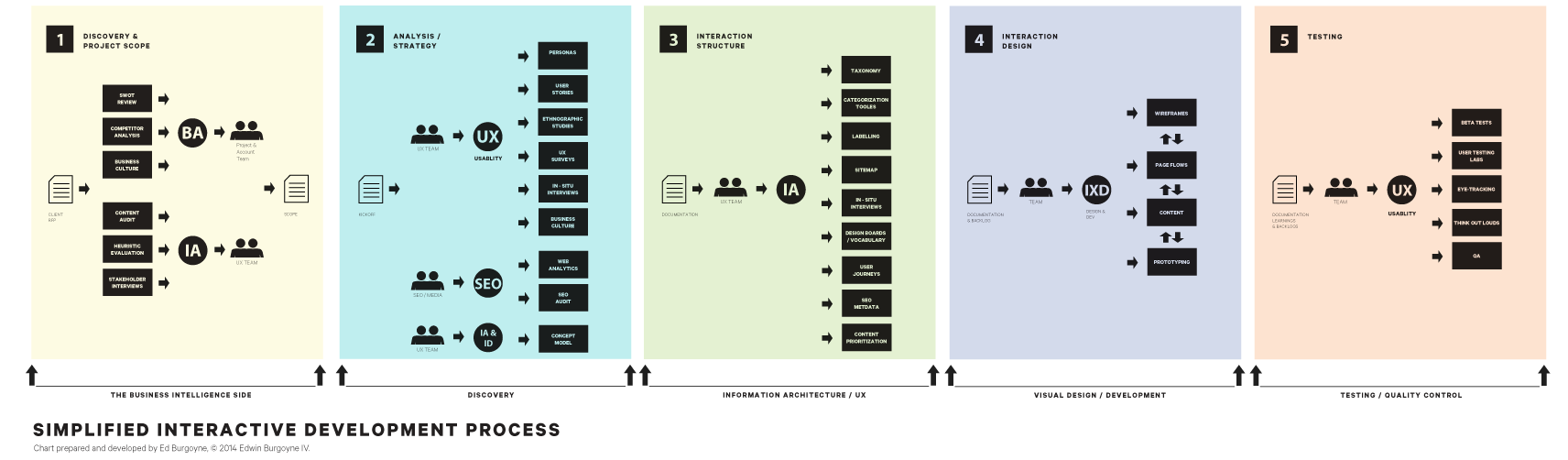

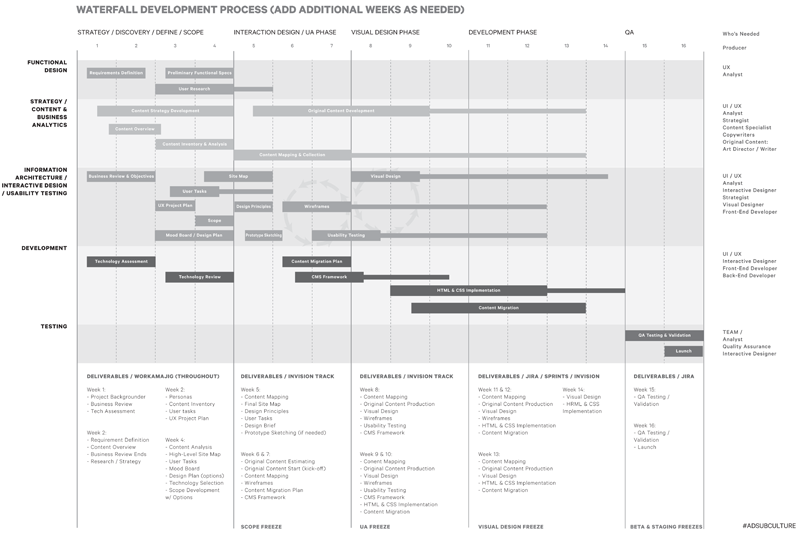
Strategy / Planning

Workflow / Process


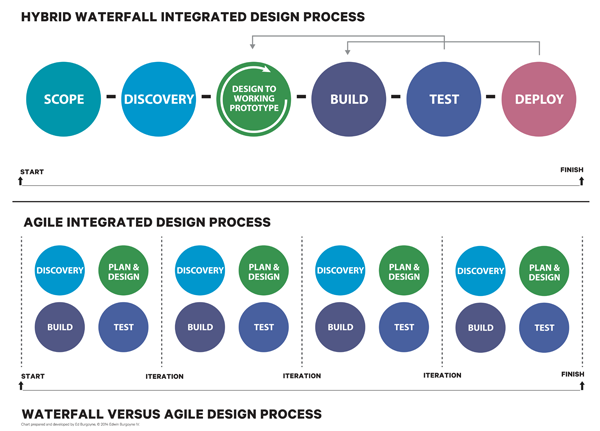
When we think about Agile, we tend to only think about it as method for development projects. Agile at its core is really about ways of working adapting quickly to changing requirements, environments, client requests and new learning.
It is about flexibility, the ability to respond to change and an agency culture where people are encouraged to collaborate and work at the highest level possible. Agile depends on capitalizing the value of the people on the team, to accept and react quickly to change.
Agile is a big shift in the way we work and tackle creative...
(It’s about ditching “the big reveal.”)
Well, agile is more than that, but that’s essentially the mind shift. Traditional process often involves a process where the agency is briefed, then the creative team goes away and works for a while. Then the agency sets a presentation day, and shows the clients the creative work they’ve been doing for the past couple of weeks.
Integrated production in creative land started out as merging the production of digital, broadcast, print and almost all other production into production department in the agency. This happened because many agencies shifted their creative philosophies, talent and structure to better orient themselves to create ideas unencumbered by specific media; agencies shifted their core principles to being media agnostic.
As agencies began to tear down silos, the transition to having one hub for managing production and project management made sense. Creative firms rarely find themselves working on one type of project anymore, and having one producer manage the content helped to coordinate the larger creative campaigns.
If you have traditional project management in your firm, it can be in the form of three common organizational structures...
Traditional project management is most commonly known for using what’s called “waterfall” to approach work in phases. It’s a pretty common way of working, you start with an ask, then you work from the top phase down to complete the project. This approach works pretty well in a number of different fields where processes are repeated. It’s also easy to understand, you start with one step, then you go to the next when you are ready.
We’ve used waterfall methodologies for decades, because it works, it’s not the most adaptable way of working, but when you have a lot of sets to get through with set deadlines it is a manageable way of working for most people.
A cross-functional team in an agency can take many forms.
These teams are small groups of individuals that cross formal or informal functional departmental boundaries and levels of hierarchy. The group is created to commit to a common purpose or goal, typically formed for a project, program or by client; the team acts and works as one unit. They communicate frequently, cooperating and providing mutual support, coordinating activities, drawing upon and exploiting the skills and capabilities from each other, while considering the needs of individual members.
Before we look forward, we should take a look back at how traditional project management has worked in agency models before. This chapter walks through some of the ways project management has grown into providing layers of gates and levels of control.
At the core of the creative agency is an understanding that you make stuff, you get your hands dirty, and you step out of your comfort zone in order to make things happen. Traditional project management does this by developing a plan that tackles the creative problems in phases.
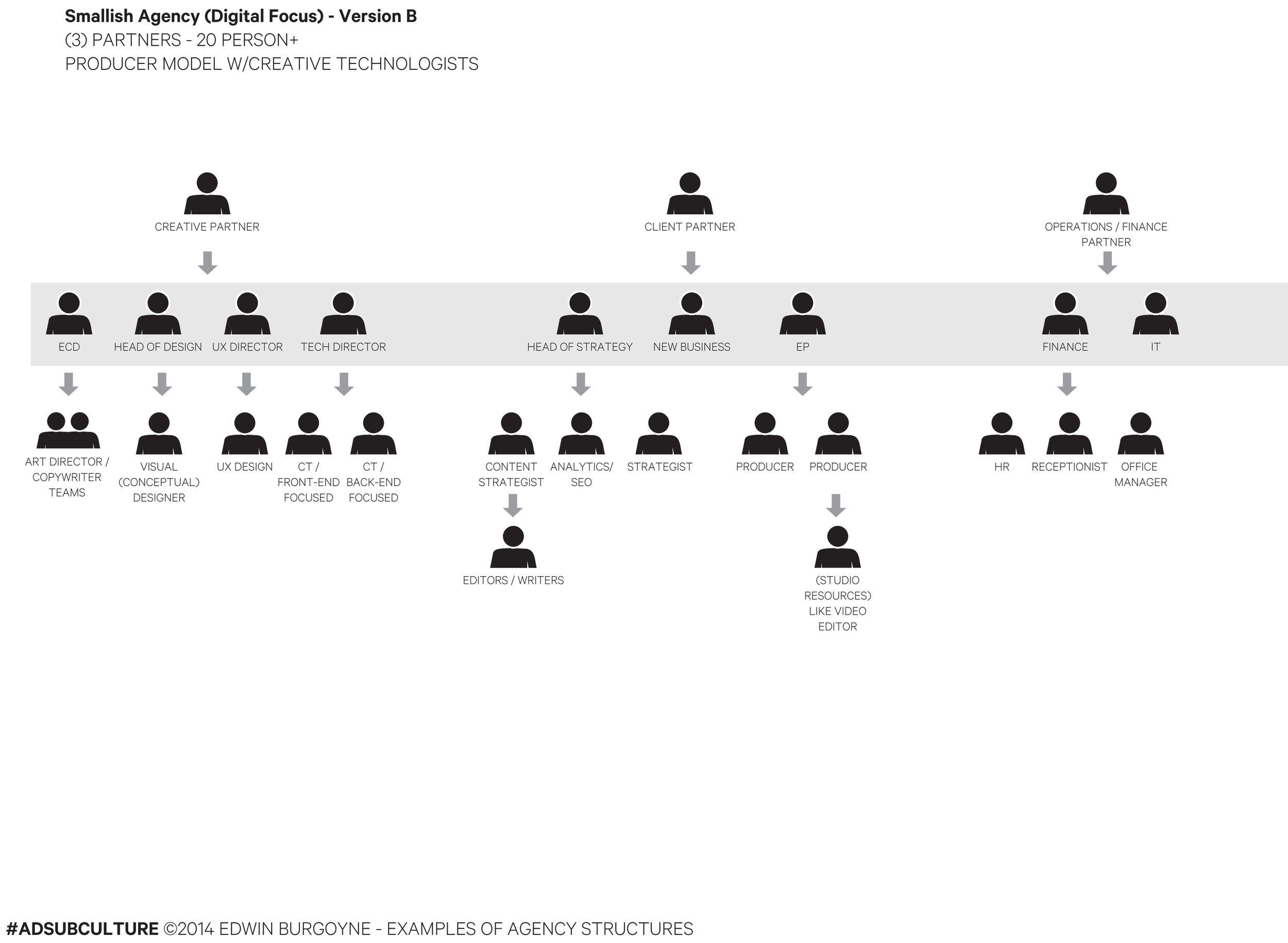
There are many different ways to staff a creative agency or firm. No two agencies are the same, and almost no powerpoint chart can show the real complexities of how an organization reports. If it did, there would be dotted lines running all over the place. The charts below are simplified organizational charts that attempt to show a few structures. To be honest, there are as many ways to staff an agency as there are agencies!
So, stick with the article, as the second section helps explain some terminology and organizational definitions. They may help you understand and identify what type of structure you may have or how to expand or contract it.



Re-Engineering
Old Skool Studio
Print Specific
Resources on the Web